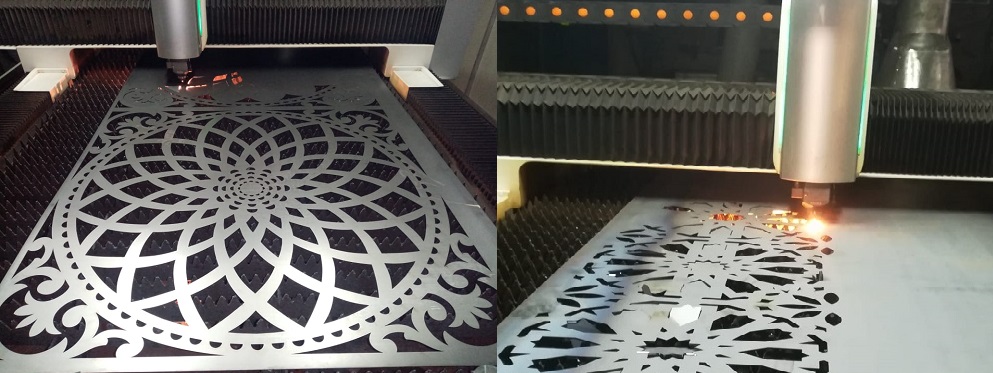
In laser cutting, a focused laser beam radiating with high energy density is used as a cutting tool for the thermal cutting process on the metal workpiece. CNC Laser Cutting Services uses oxidizing gas (N2, Air) to cut or react with reactive metals, including stainless steel,l titanium, aluminium, various metals, non-metal sheets, and composite materials.
Some Technical Specifications of Our CNC Laser
MS, GI, SS, Copperplate and tube/pipe cutting, perforation, mesh making, filter making, panels DB opening cable tray perforation, and all other designs on sheet and Pipe as client requirement
MS sheet Cutting thickness 1mm to 16 mm
Galvanized sheet Cutting thickness 1mm to 8 mm
Aluminum sheet Cutting thickness 1mm to 8 mm
Brass sheet Cutting thickness 1mm to 6 mm
copper sheet Cutting thickness 1mm to 6 mm
Cutting perforation tube/pipe 20-200mm dia 8mm thickness
Machine Bed size for sheet plate 10 feet x 5 feet (we can work at this size sheet )
Machine Bed size for sheet plate 10 feet x 5 feet (we can work at this size sheet )
Advantages of Laser Technology
CNC Laser Cutting Services is a precise and efficient method used to cut a variety of materials, including metals, plastics, wood, and more. The process involves directing a high-powered laser beam onto the material, which heats it to the point of melting, burning, or vaporizing. This concentrated energy allows for extremely accurate cuts with minimal waste.
The laser cutting process can be broken down into several key steps:
Design and Programming: The cutting design is created using CAD software and then converted into a machine-readable format known as G-code. This code instructs the laser cutter on the exact path to follow.
Material Preparation: The material to be cut is placed on the cutting bed. It may require specific preparation, such as cleaning or securing in place.
Laser Cutting: The laser beam, generated by a laser resonator, is directed onto the material. The resonator can contain various elements, such as CO2, fiber, or Nd:YAG, depending on the type of laser cutter used.
Focusing the Laser: The laser beam is focused onto a small spot using lenses and mirrors. This focused beam heats the material rapidly, causing it to melt, burn, or vaporize.
Cutting Process: As the laser moves along the path dictated by the G-code, it cuts through the material. An assist gas, such as nitrogen or oxygen, is often used to blow away molten material and enhance the cutting process.
Post-Processing: Once the cutting is complete, the finished parts may undergo additional processing, such as cleaning, deburring, or coating.